Introduction
All pupils have a legal right to a continuous education, yet many pupils spend substantial amounts of time moving in and out of the mainstream classroom. In the 2024/25 academic year alone, 94,400 pupils missed the equivalent of more than one week of school due to suspensions and a further 9,906 pupils were permanently excluded. Alongside these formal exclusionary practices, schools are frequently removing pupils from the classroom, school premises or school roll through less official means, or what we refer to as ‘under-the-radar’ exclusions.
While official data is collected on schools’ use of suspension and permanent exclusion, there is no equivalent monitoring of other exclusionary practices. As a result, relatively little is known about how frequently these practices are used or how they vary across schools. Our Exclusionary Practice in English Secondary Schools project, funded by the Nuffield Foundation, aims to address this lack of knowledge by building a more comprehensive picture of schools’ use of exclusionary practices.
This analysis focuses on one such practice: internal suspension. Internal suspension, a term recently coined in the Department for Education white paper, refers to a practice in which pupils are removed from the classroom for a period of time to complete a sanction on-site in a supervised environment. Schools more commonly call this internal exclusion, or, per the government’s Behaviour in Schools guidance, ‘classroom removal.’ In line with this guidance, we adopt the term ‘classroom removal’ throughout this analysis to refer to any practice whereby a pupil is removed from a lesson to another space on the school site. We specifically examine the reasons used for classroom removal in school behaviour policies and in teacher practice.
Managing pupil behaviour effectively while also upholding safeguarding requirements can be a difficult and complex task. We recognise that behaviour management practices, such as classroom removal, are often necessary. But like any educational practice, they warrant regular scrutiny. By examining how classroom removal is situated in school behaviour policies and in teachers’ everyday practice, we aim to build a clearer picture of their role in current school behaviour systems to inform future policy, practice and research.
Our approach
We recently commissioned a nationwide survey through Teacher Tapp to examine the use of classroom removal across secondary schools in England. This survey builds upon our previous analysis of school behaviour policies and schools’ use of internal exclusion across secondary schools in three London boroughs.
We specifically examine why teachers and leaders in state-funded English secondary schools use classroom removal as reported in both school behaviour policy and teacher practice. Our aim is to better understand the use of classroom removal and examine how the practice varies across schools according to the proportion of pupils eligible for Free School Meals (FSM). Previous research has consistently demonstrated that school exclusion rates in England vary substantially by free school meal (FSM) eligibility, with pupils from socioeconomically disadvantaged backgrounds experiencing disproportionately higher rates of suspension and permanent exclusion.
Developed in consultation with English secondary school staff, we asked 5,071 teachers and senior leaders on April 9th2026:
- ‘According to your behaviour policy, in what circumstances would a pupil be removed or withdrawn from a classroom, but stay on school site?
- Think of the last time you removed or withdrew a pupil from your lesson. What were the reasons for the removal?’
The results presented below are weighted to ensure they reflect the national population of teachers in England. Further information on the survey methodology and question wording is provided in the Additional Information section below.
What does the use of classroom removal look like in policy and practice?
We find that the most common reason for classroom removal in both policy and practice is disruptive behaviour. Nearly 85 per cent of respondents indicated that removing pupils for disruptive behaviour was included in their school behaviour policies, while almost three in four teachers (73 per cent) last removed a pupil from their classroom for disruptive behaviour. This highlights that classroom removal for disruptive behaviour is consistent across policy and practice and that for a vast majority of teachers and schools, classroom removal to another space on the school site is firmly situated as a behaviour management approach to disruptive behaviour.
Figure 1: Circumstances / reasons for classroom removal
In behaviour policy
In policy, a smaller, yet still substantial, proportion of teachers report that pupils can be removed from the classroom to another space on the school site for missing detention (43 per cent), not following uniform policy (38 per cent), not following the mobile phone policy (35 per cent), or for reaching a set number of ‘behaviour points’ or similar (39 per cent). With over a third of teachers reporting that these circumstances are included within their school behaviour policy, classroom removal to another space on the school site is further situated not only as a behaviour management tool but as a disciplinary sanction.
Despite the prevalence of classroom removal as a tool for discipline and disruptive behaviour, over half of teachers also report that their behaviour policies include classroom removal as a way for pupils to regulate their emotions (58 per cent) and to access additional educational (55 per cent) and pastoral support (53 per cent). Furthermore, 48 per cent of teachers report that according to their behaviour policies, pupils returning from long periods of absence or out-of-school exclusion may be placed outside the mainstream classroom as part of the reintegration process. These findings provide evidence that a substantial proportion of schools frame this practice not only as a disciplinary sanction but sometimes as a ‘withdrawal pathway’ providing additional support outside of the mainstream classroom.
In teacher practice
In practice, a very different picture emerges. Only a small proportion of teachers, roughly a quarter, indicate that they last removed a pupil for a reason other than disruptive behaviour, and only 5 per cent report that they have never removed a pupil before. The most likely reasons following disruptive behaviour were to help pupils regulate their emotions (14.8 per cent) or for reaching a set number of ‘behaviour points’ or similar (11.5 per cent). Very small proportions of teachers and leaders report any other reason for which they last removed a pupil (less than 6 per cent).
Removal for emotional regulation, and for sanctioning as part of behavioural point systems, demonstrates that classroom removal is not only situated as a dual pathway to sanction and support in policy, but in practice as well. While behaviour policies describe a broad range of potential uses, teachers’ reported practice is considerably narrower. Beyond disruptive behaviour, teachers’ reported reasons for classroom removal are dominated by these two purposes: emotional regulation emerging as the principal supportive reason and behavioural points systems as the principal disciplinary reason.
The relatively low prevalence of classroom removal for reasons other than disruptive behaviour, regulating emotions, and behaviour points should not necessarily be interpreted as evidence that schools are not providing this support. Instead, it may reflect that schools are more likely to use other, planned forms of provision than ad hoc classroom removals. For example, teachers may be more likely to implement additional educational or pastoral support outside the classroom as a pre-planned intervention rather than as an ad hoc removal. Further research should more closely examine the use of behaviour management tools in conjunction with pre-planned interventions for additional support, such as inclusion bases in schools.
For internal exclusion
The largest discrepancy between policy and practice surrounds the use of classroom removal as internal exclusion. Nearly 80 per cent of teachers and leaders reported that internal exclusion was included in their behaviour policy, yet less than 5 per cent of teachers and leaders reported that the last time they removed a pupil was for an internal exclusion. The small proportion of teachers indicating internal exclusion likely reflects that internal exclusion is not necessarily conceptualised as a reason they use for removal but rather as the removal process itself. Therefore, it would be in line with our survey findings that internal exclusion would be included within school behaviour policies but not as a reason for removal cited by teachers.
Nevertheless, the widespread association of classroom removal with internal exclusion within behaviour policies is particularly noteworthy, as some inclusion experts and school leaders have expressed concern that the term ‘internal exclusion’ can carry punitive or negative associations. Reflecting these concerns, some schools have adopted a range of alternative labels for the practice that emphasise reintegration and inclusion rather than punishment. However, with 79 per cent of teachers reporting that ‘internal exclusion’ is included as a circumstance for removal in their school behaviour policy, the findings suggest that the term remains widely used or, at the very least, widely recognised.
Overall, the distribution of responses suggests that classroom removal is widely used and primarily functions as a behaviour management tool for disruptive behaviour. Yet a more complex narrative emerges as classroom removal is simultaneously positioned and used as a pathway to either sanction pupils or provide additional support. Overlapping purposes in policy and practice raise questions around how schools and teachers might be using the practice in place of other resources to meet additional classroom and pupil needs.
How does the use of classroom removal vary by FSM?
We also examine how the use of classroom removal in both policy and practice varies by Free School Meals (FSM) quartile. FSM quartile refers to the proportion of pupils eligible for FSM in a respondent’s school. Further details on how FSM quartiles are calculated for secondary schools are provided in the Additional Information section.
Based on our findings, we group the circumstances and reasons teachers and leaders report for classroom removal into two categories: discipline and support. Classroom removal for disciplinary circumstances and reasons include:
- disruptive behaviour
- internal exclusions
- not following the uniform policy
- not following the mobile phone policy
- missing detention(s)
- reaching a set number of ‘behaviour points’ or similar (abbreviated as ‘Behavioural points system’ in the figures below).
Classroom removal for supportive circumstances and reasons include:
- reintegration from long periods of absence or exclusion
- to access additional educational support (e.g. 1-1 tutoring)
- to access additional pastoral support
- to regulate their emotions.
We recognise that these are not formal categories and are therefore subject to different interpretations. We caution against interpreting labels attached to each group as prescriptive of all uses of classroom removal. Not all uses of classroom removal will necessarily be disciplinary or supportive, yet for the purposes of this analysis we use the groupings to draw attention to wider trends in classroom removal practice.
Disciplinary trends by FSM – in policy
Respondents in higher FSM quartiles, meaning that they work in schools serving larger proportions of pupils eligible for FSM, are more likely to report that in their behaviour policy, pupils can be removed for low-level disciplinary sanctioning: not following the uniform policy, not following the mobile phone policy, and as part of their behaviour points system[1].
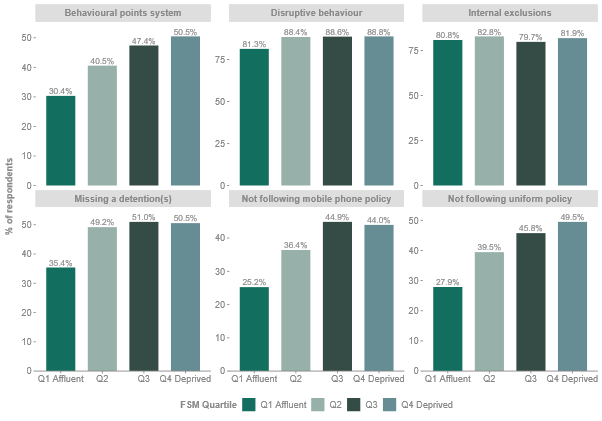
Figure 2: Prevalence of disciplinary circumstances in school behaviour policies for classroom removal
In particular, for each increase in FSM quartile, teachers and leaders are, on average, 6.7 percentage points more likely to report that their school behaviour policy includes classroom removal as part of a behavioural points system, and 7.2 percentage points more likely to report that it includes classroom removal for not following the uniform policy. Schools in the lowest FSM quartile, meaning they serve the lowest proportions of FSM-eligible pupils, are particularly less likely to mention these circumstances. Previous research has found similar patterns of inequalities between FSM and uniform-related discipline and school uniform policies, demonstrating an emerging pattern in which disadvantaged pupils are more likely to lose learning time in the mainstream classroom for low-level offences than their wealthier peers.
In contrast, ‘Internal exclusion’ is consistently reported across all FSM quartiles, underscoring that the term is not only widely recognised but equally prevalent across levels of school disadvantage. The prevalence of disruptive behaviour as a circumstance for removal is reported by roughly 88 per cent of respondents across all FSM quartiles except the lowest quartile – where teachers and leaders are around seven percentage points less likely to report this.
Disciplinary trends by FSM – in practice
Relatively similar patterns to school behaviour policies emerge across school FSM eligibility for teachers’ use of classroom removal. Again, disruptive behaviour is cited as a reason for removal consistently across the top three FSM quartiles (Q2, Q3, and Q4) while those serving the smallest proportions of FSM-eligible pupils are nine percentage points less likely to have last removed a pupil for disruptive behaviour. This indicates that in addition to having different behaviour policies, some schools are using different behavioural management tools or experiencing less classroom disruption, and that they tend to be concentrated in the lowest FSM quartile.
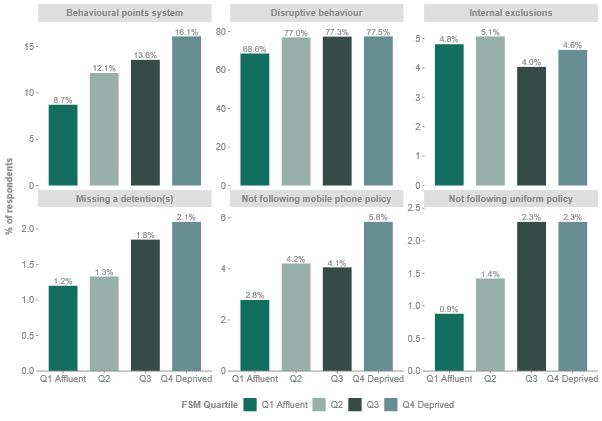
Figure 3: Prevalence of disciplinary reasons for removing pupils from the classroom
There is also a particularly strong relationship between FSM quartile and removing pupils who reach a set number of ‘behaviour points’ or similar. Teachers working in schools in the highest FSM quartile are almost twice as likely to have last removed a pupil as part of a behaviour points system, than teachers working in schools in the lowest FSM quartile. Similar, albeit weaker, relationships are also evident between FSM quartile and low-level disciplinary removals for reasons such as missing detention and not following the uniform or mobile phone policy.
Supportive trends by FSM – in policy
While across disciplinary circumstances, and for low-level discipline, a clear trend of increasing prevalence across FSM quartile is exhibited, the same trend is not evidenced for classroom removal for more supportive circumstances.
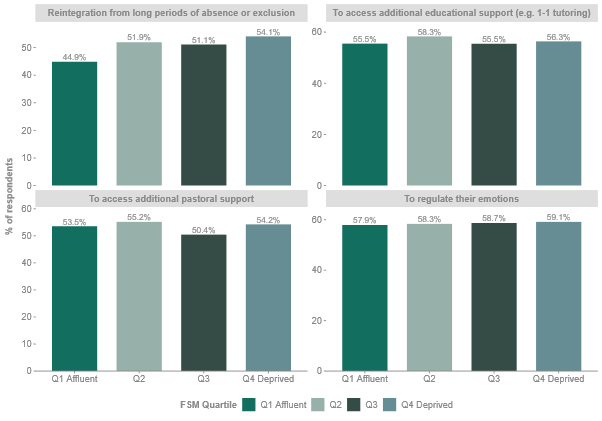
Figure 4: Prevalence of supportive circumstances in school behaviour policies for classroom removal
Instead, across all FSM quartiles we see that roughly half of teachers report that their school behaviour policy includes 1) Reintegration from long periods of absence or exclusion, 2) To access additional educational support, 3) To access additional pastoral support, 4) To regulate their emotions as circumstances for removal. The only exception being that schools in the lowest FSM quartile are marginally less likely to include reintegration from long periods of absence or exclusion as a circumstance that pupils can be placed outside the mainstream classroom for.
Supportive trends by FSM – in practice
In practice, there is also relatively little variation, and no clear patterns emerge across FSM quartile in terms of teachers removing pupils for supportive reasons. Instead, teachers and leaders appear to nominally use classroom removal to help pupils regulate their emotions, access additional pastoral and educational support, and for reintegration. The lack of trends between FSM quartile and teacher use of classroom removal for supportive reasons is consistent with our above findings on school behaviour policies.
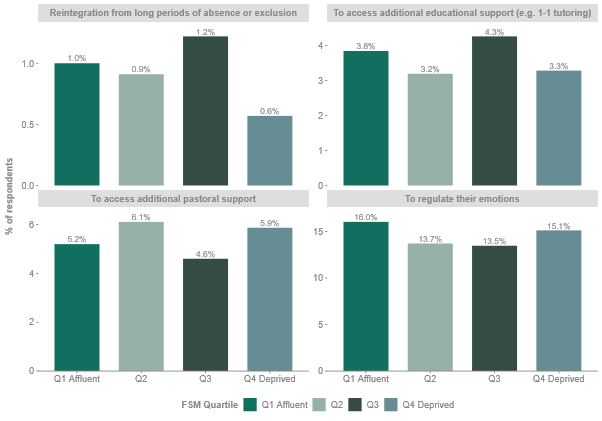
Figure 5: Prevalence of supportive reasons for removing pupils from the classroom
Unlike disciplinary uses of classroom removal, supportive uses show only modest variation across FSM quartiles, with no clear gradient or trend emerging. This absence of a systematic pattern should not necessarily be interpreted as evidence of equity. Given that we know many disadvantaged schools face higher levels of need, one might expect schools serving higher proportions of FSM-eligible pupils to be more likely, on average, to use classroom removal to provide additional support to pupils. Coupled with the clearer inequalities observed in disciplinary uses of classroom removal, these patterns provide a clear incentive for future research to more closely investigate inequalities in classroom removal.
More concerning is that only half of schools explicitly link classroom removal to additional support in their behaviour policy and that a much smaller proportion of teachers and leaders are then using classroom removal to provide support in practice. Failing to link classroom removal to additional support in practice and policy is particularly concerning, as it demonstrates a lack of acknowledgment of how underlying needs often drive disruptive behaviour. While additional support outside the classroom may be being provided through other practices beyond classroom removal, it is still important that behaviour policies explicitly recognise the link between need and behaviour.
Conclusion
This analysis demonstrates that classroom removal is now a deeply embedded feature of behaviour management in English secondary schools. We find that classroom removal is primarily understood and used as a response to disruptive behaviour, with almost three-quarters of teachers reporting that the last pupil they removed from their classroom was removed for this reason. Furthermore, the widespread inclusion of internal exclusion within school behaviour policies suggests that removal from the classroom has become a normalised and institutionalised disciplinary practice.
At the same time, we find that classroom removal is situated to serve multiple overlapping and sometimes competing purposes, ranging from helping pupils regulate their emotions to serving as a low-level disciplinary sanction for mobile phone or uniform infractions. The breadth of these reported purposes suggests that classroom removal has evolved into a flexible practice that schools draw upon in response to a wide range of challenges and needs. However, such flexibility also raises important questions about the extent to which different uses of classroom removal are underpinned by clear educational objectives and whether distinct purposes lead to varying experiences and outcomes for pupils from different backgrounds
We also find significant inconsistencies between school behaviour policy and teacher practice. Although supportive uses of classroom removal are acknowledged in many school behaviour policies, they are considerably less evident in teachers’ reported use of the practice. This suggests that, in practice, classroom removal remains overwhelmingly oriented towards managing disruptive behaviour rather than addressing the underlying needs that may contribute to misbehaviour. Given ongoing concerns regarding the capacity of schools to meet additional needs, including special educational needs and disabilities (SEND), future research should consider the extent to which classroom removals represent an effective and appropriate means of enabling schools to support children and young people with additional needs.
This analysis also highlights important inequalities in the use of classroom removal. Schools serving higher proportions of pupils eligible for Free School Meals are more likely to include low-level disciplinary reasons for removal within their behaviour policies and remove for these reasons in practice. In contrast, supportive uses of classroom removal are not skewed in favour of schools with more disadvantaged pupils. Together, these findings raise important considerations about equity within the education system. If pupils in more disadvantaged schools are more frequently exposed to disciplinary forms of classroom removal, there is a risk that differential experiences of exclusionary practices may contribute to existing educational inequalities.
Overall, these findings underline the need for greater transparency and systematic monitoring of classroom removals, particularly given the absence of national data. Our analysis here only captured teachers’ and leaders’ perceptions surrounding the use of classroom removal practices. Without robust evidence on frequency and duration, it is difficult to assess whether classroom removal is truly supporting pupils’ educational engagement or contributing to patterns of exclusion and disadvantaged pupils’ outcomes. We recommend that school leaders and policymakers explore the potential benefits and costs of capturing lesson-level information on pupils who are receiving parts of their education outside the mainstream classroom.
Forthcoming research as part of the Exclusionary Practice in English Secondary Schools will more closely examine the wider landscape of exclusionary practice, including the use of off-site direction, managed moves, off-rolling, and part-time timetables and how these practices relate to the use of external exclusion at the school and pupil level. In addition, future work with Teacher Tapp will be leveraged to survey teachers about the level of provision and support provided to pupils removed from the classroom. As classroom removal continues to occupy a central place within school behaviour systems, developing a clearer understanding of why, when, and to what ends it is used will be essential for ensuring that policy and practice are both effective and equitable.
Full answer choice options to survey questions
In response to the question, ‘According to your behaviour policy, in what circumstances would a pupil be removed or withdrawn from a classroom, but stay on school site?’ teachers could select the multiple responses for the following choices:
- Reaching a set number of ‘behaviour points’ or similar
- Disruptive behaviour
- Not following the mobile phone policy
- Not following uniform policy
- Missing a detention(s)
- To access additional pastoral support
- To access additional educational support (e.g. 1-1 tutoring)
- To regulate their emotions
- Reintegration from long periods of absence or exclusion
- Internal exclusions
- I don’t know
- Not relevant / cannot answer
In response to the question, ‘Think of the last time you removed or withdrew a pupil from your lesson. What were the reasons for the removal?’ teachers could select multiple responses for the following answer choices:
- Reaching a set number of ‘behaviour points’ or similar
- Disruptive behaviour
- Not following the mobile phone policy
- Not following uniform policy
- Missing a detention(s)
- To access additional pastoral support
- To access additional educational support (e.g. 1-1 tutoring)
- To regulate their emotions
- Reintegration from long periods of absence or exclusion
- Internal exclusions
- I can’t remember
- I’ve never done this
- Not relevant / cannot answer
Additional survey questions
Alongside the questions and results presented above we also asked teachers and leaders the following questions:
- Does your school have any of the current systems in place?
- Pupils are taken out of class to another provision or space on the school site for extra support
- Pupils are taken out of class to another provision or space on the school site as a sanction for behaviour
- Pupils are taken out of class to another provision or space shared between multiple schools for extra support
- Pupils are taken out of class to another provision or space shared between multiple schools as a sanction for behaviour
- When pupils are taken out of class, where do they go?
- Another mainstream classroom (e.g. via a ‘shadow timetable’)
- A shared school space (e.g. the corridor, staff office)
- Dedicated spaces for pupils who have been removed or withdrawn (e.g. ‘Removal Room’)
- Internal alternative provision unit or similar in-school provision
Calculating FSM quartile
Quartile 1 (Q1) includes the 25% of secondary schools with the lowest proportion of FSM-eligible pupils, Quartiles 2 and 3 (Q2 and Q3) represent the middle 50%, and Quartile 4 (Q4) includes the 25% of schools with the highest proportion of FSM-eligible pupils. For secondary schools, the quartile cut points are 11.6%, 18.6%, and 28.2% per cent FSM-eligible pupils.
Thank you to all teachers and leaders who participated in our survey development workshop.
This project has been funded by the Nuffield Foundation, but the views expressed are those of the authors and not necessarily the Foundation. Visit nuffieldfoundation.org
[1] Full answer choice was ‘Reaching a set number of “behaviour points” or similar’. Shortened to ‘Behavioural points system’ in Figures 2 and 3.