
A new National Framework, an old local lottery
Since the pandemic, rising pupil absence has been one of the biggest challenges facing schools in England, with mounting evidence linking absence to worse GCSE and longer-term outcomes, and the widening disadvantage attainment gap.
The government has been championing a support-first approach to tackling pupil absence, while also implementing national standards for absence fines, known as Penalty Notices (PNs).
Established in August 2024, the new National Framework attempts to standardise enforcement of PNs to address the ‘postcode lottery’ in absence fines across different local authorities (LAs). It requires all schools to consider issuing an £80 fine when a child has missed 10 unauthorised sessions (five days) within a 10-week rolling period. Rising to £160 if paid after 21 days but before 28 days (at which point headteachers and LAs can prosecute parents).
With the schools white paper announcing a new attendance target of over 94 per cent, it is a timely opportunity to look at the most recent official data on ‘parental responsibility measures’, which coincides with the first year of the new National Framework.
Our analysis reveals that while the threshold for issuing absence fines is now national, its enforcement remains geographically unequal.
Despite plateauing, absence fines remain at an all-time high
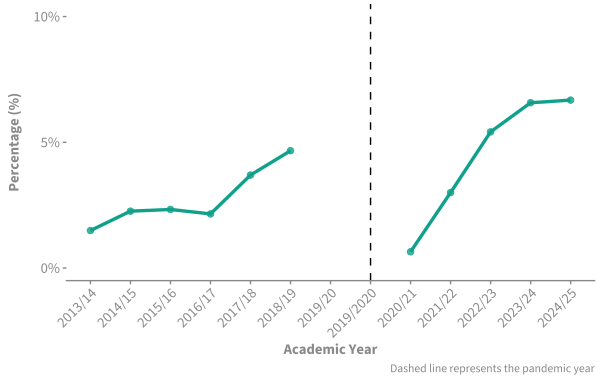
Figure 1 shows that nationally, the rate of PNs issued reached 6.7 per cent of total pupil enrolments (children aged 5 – 15 attending state-funded schools) in England during the 2024/25 academic year. Following the tightening of penalty notice enforcement in 2017, rates were rising steadily until Covid-19, dropped during the pandemic, and subsequently rose to unprecedented levels. This latest trend likely reflects the on-going push to improve the post-pandemic rise in pupil absences.
Despite levelling off in 2024/25, PN rates remain at an all-time high and well above pre-pandemic levels, even as unauthorised absences have fallen compared to 2023/24.
Family holidays account for 7.1 per cent of all absences, yet they account for 93 per cent of all fines. This suggests a disconnect between the root causes of absences and how families are targeted for enforcement.
Figure 1: National trend in percentage of PNs issued by enrolment from 2013/2014 to 2024/2025
Behind the national rate stand marked geographical differences
The National Framework was introduced with the aim to create greater consistency in how penalty notices are used across England. However, our analysis shows that marked geographical differences remain one year on.
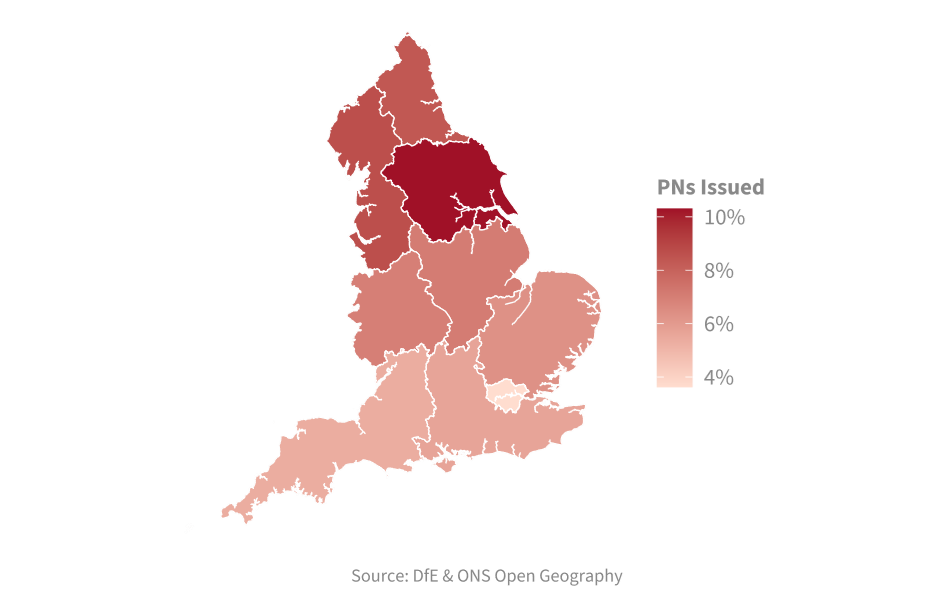
As Figure 2 shows, London issued the fewest fines in the country (at just 3.6 per cent of enrolments), while Yorkshire and the Humber issued almost three times as many (10.3 per cent). While these regional differences may be partially driven by varying pupil characteristics and local contexts – which we do not account for in this analysis – a disparity of this size suggests that local approaches to unauthorised absences and fines remain an important factor.
Regional differences are further reflected in prosecutions due to non-payment. In 2024/25, 11 per cent of fines in the North East ended up in court – nearly double the national average of 6 per cent. The North West and Yorkshire and the Humber also saw high escalation rates, with 8 per cent of fines leading to prosecution for non-payment.
At a local authority (LA) level, there were 17 LAs with no prosecutions due to non-payment whatsoever, and of these 13 were in London or the South.
Therefore, despite the National Framework aiming for more consistency, it is clear that some areas – notably in the North –both issue fines at a higher rate and face greater challenges with non-payment.
Figure 2: Geographical differences in PN rates across LAs in England in 2024/25
Local challenges with unauthorised absence are only part of the story
Since the introduction of the National Framework, fines have become less concentrated in a small number of LAs: in 2024/25, 33 LAs (out of 153) issued half of all PNs nationally, compared to 22 LAs in 2023/24. While this indicates that PNs are being used more broadly across the country, significant local disparities remain.
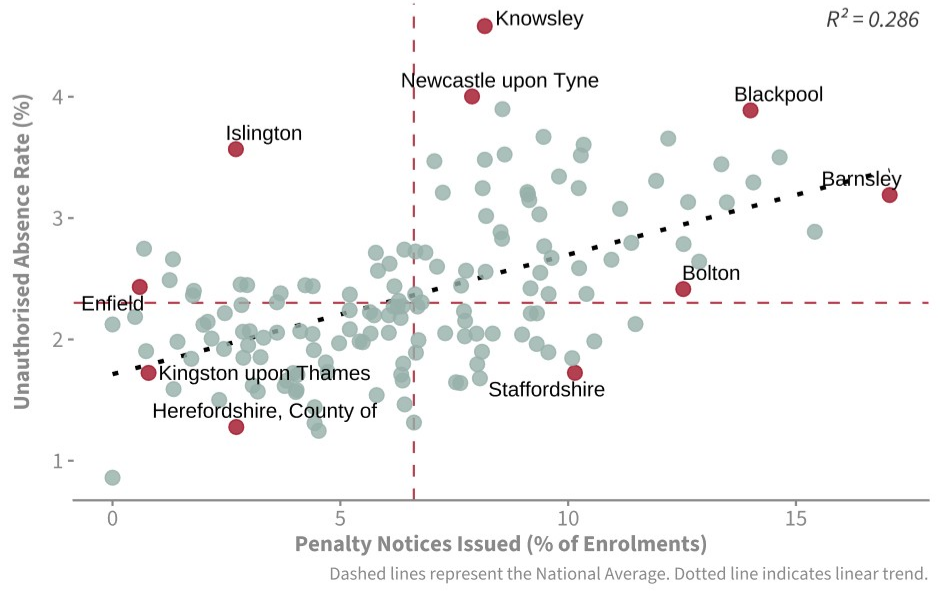
Figure 3 shows rates of PNs issued against the rates of unauthorised absences for each area. The overall relationship is loosely as expected – as unauthorised absence rates increase, so do fines. Correspondingly, we find 29 per cent of the variation in fine rates between LAs is explained by unauthorised absences. However, some LAs appear to buck this trend.
Barnsley has the highest rate of PNs issued nationally, but a lower unauthorised absence rate than 22 other local authorities. Of the three LAs with the highest levels of unauthorised absence in the country, Blackpool issues far more PNs – 14 per cent of pupils – than both Knowsley (8.2 per cent) and Newcastle upon Tyne (7.9 per cent).
At the other extreme, we see LAs such as Kingston upon Thames and Staffordshire, with relatively low rates of unauthorised absence (both 1.7 per cent of total absences) but variable use of PNs – Kingston upon Thames at 0.8 per cent and Staffordshire at over twelve times this rate (10.2 per cent). In contrast, Islington, despite having a far higher unauthorised absence rate than County of Herefordshire, issued the same low rate of PNs (both 2.7 per cent).
Meanwhile, Enfield and Bolton both had unauthorised absence rates near the national average, but Bolton had a far greater reliance on PNs (12.5 per cent) compared to Enfield (just 0.6 per cent).
Figure 3: Penalty notices issued by unauthorised absence rates across LAs in 2024/25
Taken together, the data shows that even though absence fines have plateaued nationally, there remains significant local variation, even when faced with similar rates of unauthorised absence.
Disadvantaged students and their families may face additional pressures to pay fines
The data suggests some geographical overlap between disadvantaged areas and high rates of PNs, large numbers of PNs paid late, and high proportions of prosecution due to non-payment.
Figure 4 shows for each LA, the proportion of fines resulting in late payment or prosecution for non-payment, by the percentages of disadvantaged pupils. These graphs suggest that those LAs with some of the highest proportions of PNs being paid late – North Lincolnshire, Rochdale and Islington – also have relatively high levels of disadvantaged students (all above the national average).
Likewise, for LAs such as Middlesbrough, Kingston upon Hull, and Halton, a high proportion of fines escalated to court for non-payment, and these areas all have high concentrations of disadvantaged students.
Figure 4: Proportion of PNs issued that result in late payment or prosecution for non-payment by percentage of FSM students in each local authority[1]
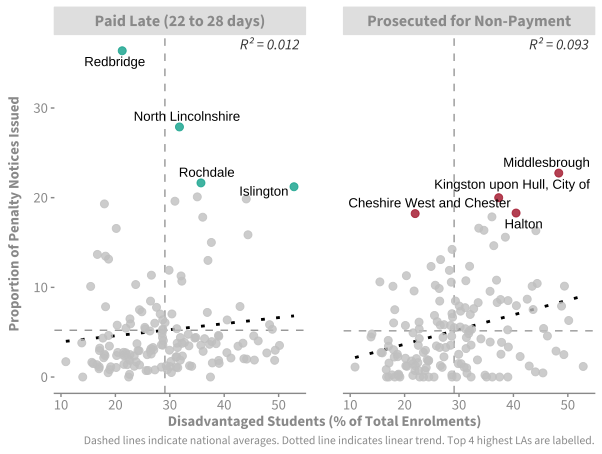
However, there is not a particularly strong national relationship between an LA’s level of disadvantage and variation in either late payments or prosecutions for non-payment: the percentage of disadvantaged students in a given LA only accounts for 1.2 per cent and 9.3 per cent of the variation in late and non-payments, respectively.
This underscores how enforcement actions are not unique to disadvantaged students and their families. There are less-disadvantaged areas that similarly struggle with fines being paid late (Redbridge) or a high reliance on prosecutions for non-payment (Cheshire West and Chester).
A regional approach to a regional challenge
This analysis has shown that despite a plateauing of overall rates of PNs across England, there remains a substantial postcode lottery for enforcement. Even with the introduction of the new National Framework, there are still differences in local use of fines, which cannot be fully explained by rates of unauthorised absences.
The new Framework for Penalty Notices is a blunt tool for dealing with the root causes of unauthorised absences. These fines run the risk of targeting a tiny fraction of the overall absence challenge and placing additional financial pressure on families during a cost-of-living crisis. This has the potential to undermine important parent-school relationships and especially in LAs with high numbers of disadvantaged students, where the need for support-first approaches may be greatest.
Ultimately, some local authorities continue to deploy a more punitive approach, which evidence suggests is unlikely to be effective in combating unauthorised absences. To achieve the attendance target set out by the schools white paper, policy must make support-first a reality in all local authorities; whether that involves reviewing the effectiveness of penalty notices, alongside addressing unmet Special Educational Needs and Disabilities (SEND) provision, improving student mental health and belonging at school, and prioritising targeted funding for the most disadvantaged students.