English secondary school pupils are being removed from the classroom at dramatically increasing rates – rising from five per cent of pupils in the 2022/23 academic year to 13 per cent in 2025/26. Classroom removals, sometimes referred to as internal suspensions or exclusions, have not previously been classified as official forms of exclusion and, as a result, there is no nationally collected data on them.
Little is therefore currently known about their use. This lack of knowledge surrounding classroom removal stands in stark contrast to what appears to be its widespread use. Our current research on Exclusionary Practice in Secondary Schools aims to directly address this evidence gap by investigating classroom removals, alongside the full range of practices being used in schools.
This analysis specifically focusses on what teachers and schools call the spaces pupils are removed from the classroom to. Our research has previously examined the rates of and reasons for removing or internally excluding pupils from the classroom. We found that classroom removal is a normalised and institutionalised disciplinary practice, and that more disadvantaged schools are more likely to remove pupils for low-level misbehaviour. By investigating the official names of removal spaces, we aim to build on our past work by examining how removal spaces are conceptualised within schools and discussing what this reveals about practice itself.
Our approach
We recently commissioned a series of survey questions through Teacher Tapp to investigate the use of classroom removals. We received 2,603 responses from secondary school teachers and senior leaders to the following open question:
‘What do you call the name of the space(s) where pupils go when withdrawn or removed from their lesson?’
An iterative thematic approach, alongside quantitative text analysis, was used to identify recurring themes and phrases across teacher responses. Responses were coded inductively, meaning that rather than starting from predefined categories, we developed themes from patterns in the data itself. This exploratory approach let us capture the most common ways teachers name these spaces.
Names that did not clearly fit an existing theme were initially assigned to an ‘Other’ category, which we revisited throughout the analysis. Those left in ‘Other’ at the end of this process were rare or ambiguous cases.
This analysis specifically focusses on the names of classroom removal spaces rather than the nature of provision in these spaces. We explore how space names might simultaneously reflect and produce differing conceptualisations of the purpose of classroom removal. However, while the names can signal what a school intends a space to function as, we cannot say how far those ideas carry through into practice.
Basic trends
Following data cleaning and standardisation (see [additional information]), we identified a total of 3,771 individually named spaces. Most teachers (71 per cent) reported a single name, yet a significant proportion listed multiple spaces, evidencing the sometimes complex and layered systems schools are using outside the mainstream classroom.
Figure 1: Number of spaces named by respondents
| Number of names listed | Per cent of respondents | Number of respondents |
|---|---|---|
| 1 | 71.2 | 1,854 |
| 2 | 18.1 | 472 |
| 3 | 6.9 | 179 |
| 4 | 2.6 | 68 |
| 5+ | 1.2 | 30 |
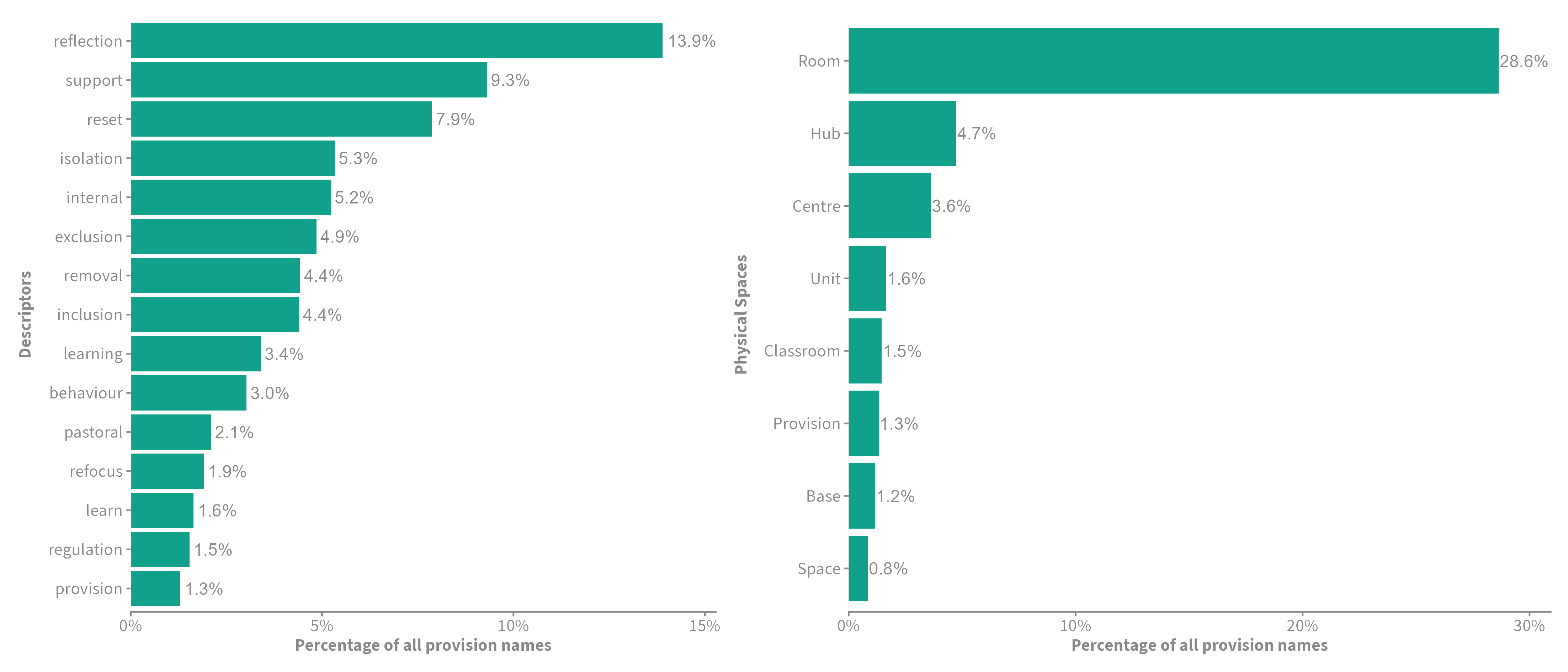
Across space names, the most common word was ‘reflection’, with roughly 1 in 10 responses including this word. Respondents also frequently reported spaces with the words ‘support’, ‘reset’, or ‘isolation’ in their names. As seen below in Figure 2, there was no one clear word being used across spaces. Instead, there is considerable variation across removal space names. Such variation reflects the lack of official policy and standardised terminology regarding classroom removals, as well as schools’ autonomy to tailor room names to their specific school culture.
Teachers and leaders predominantly refer to classroom removal spaces as designated ‘rooms’, representing how removal is an institutionalised and centralised part of schools’ behaviour management. In some cases, where teachers report spaces termed ‘hub’, ‘centre’, ‘unit’, ‘base’, or ‘space’, a clearer distinction is made. Removal spaces referred to as hubs, centres, units, or bases likely reflect these spaces’ capacity to provide more specialised provision or longer-term use compared to other removal ‘room’ spaces.
Figure 2: Most common words across respondents
Thematic trends and analysis
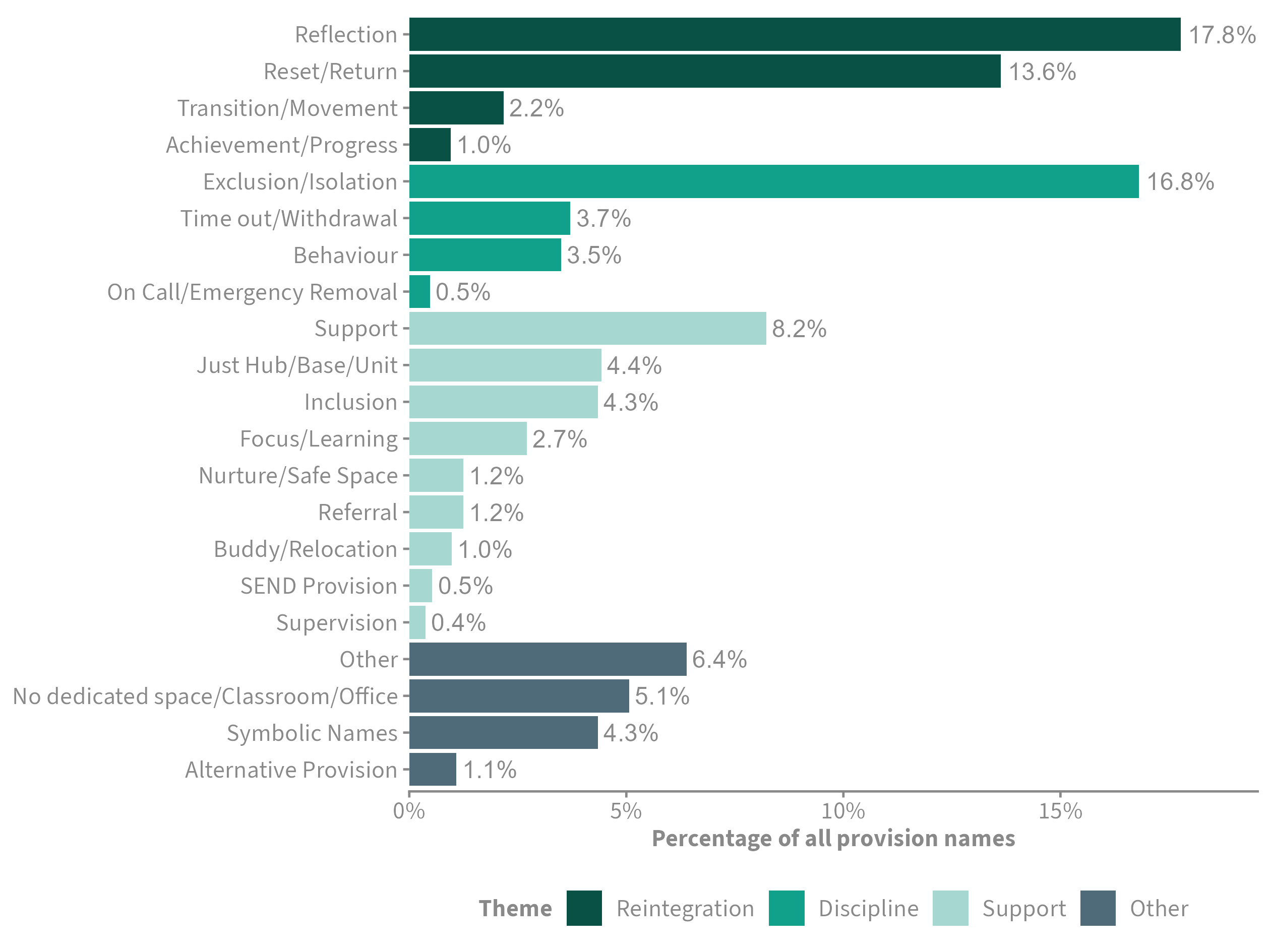
To examine patterns across space names, we clustered responses into 21 groups. As seen in Figure 3, the most common cluster was centred around reflection, closely followed by exclusion / isolation and then support.
From these 21 groups, we identified three major overarching themes: 1) reintegration; 2) discipline; and 3) support, which we present in more detail below.
Figure 3: Thematic classroom removal space names groups
Reintegration
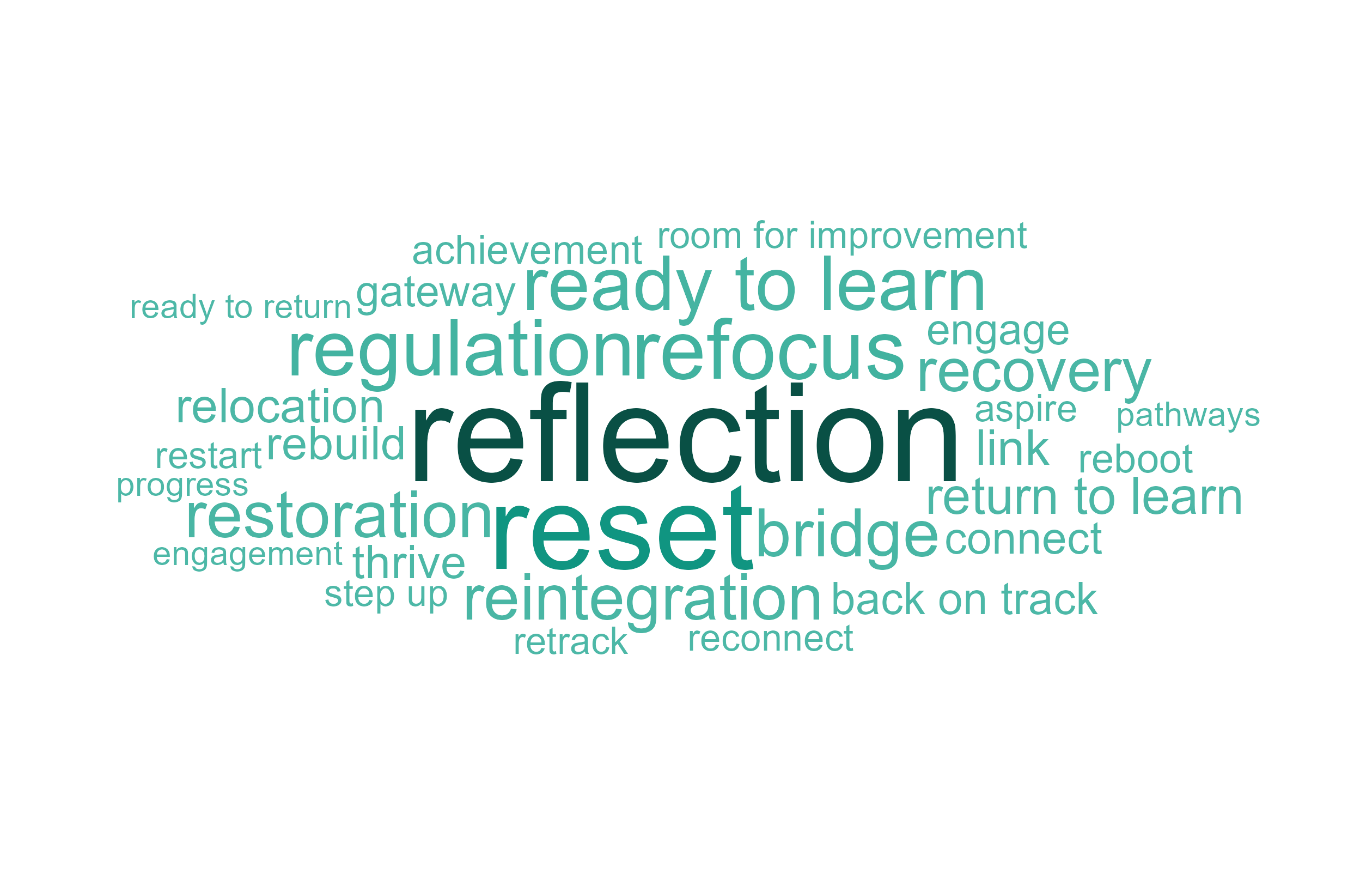
This theme predominantly features names with the prefix ‘re-’, such as reflection, reset, and refocus, indicating a return to a prior state. These names are therefore orientated around getting pupils back into the mainstream classroom, or ‘back on track’, and also tend to emphasise emotional regulation. Yet we also see space names such as ‘ready to learn’ or using the word ‘achievement’, signifying a focus on removal for academic improvement. The contrast between names that frame classroom removal around emotional stabilisation versus those focused on academic learning mirrors the wider environment in which schools operate – where practitioners must increasingly balance external attainment pressures with rising levels of additional need.
Figure 4: Reintegration theme word cloud
Discipline
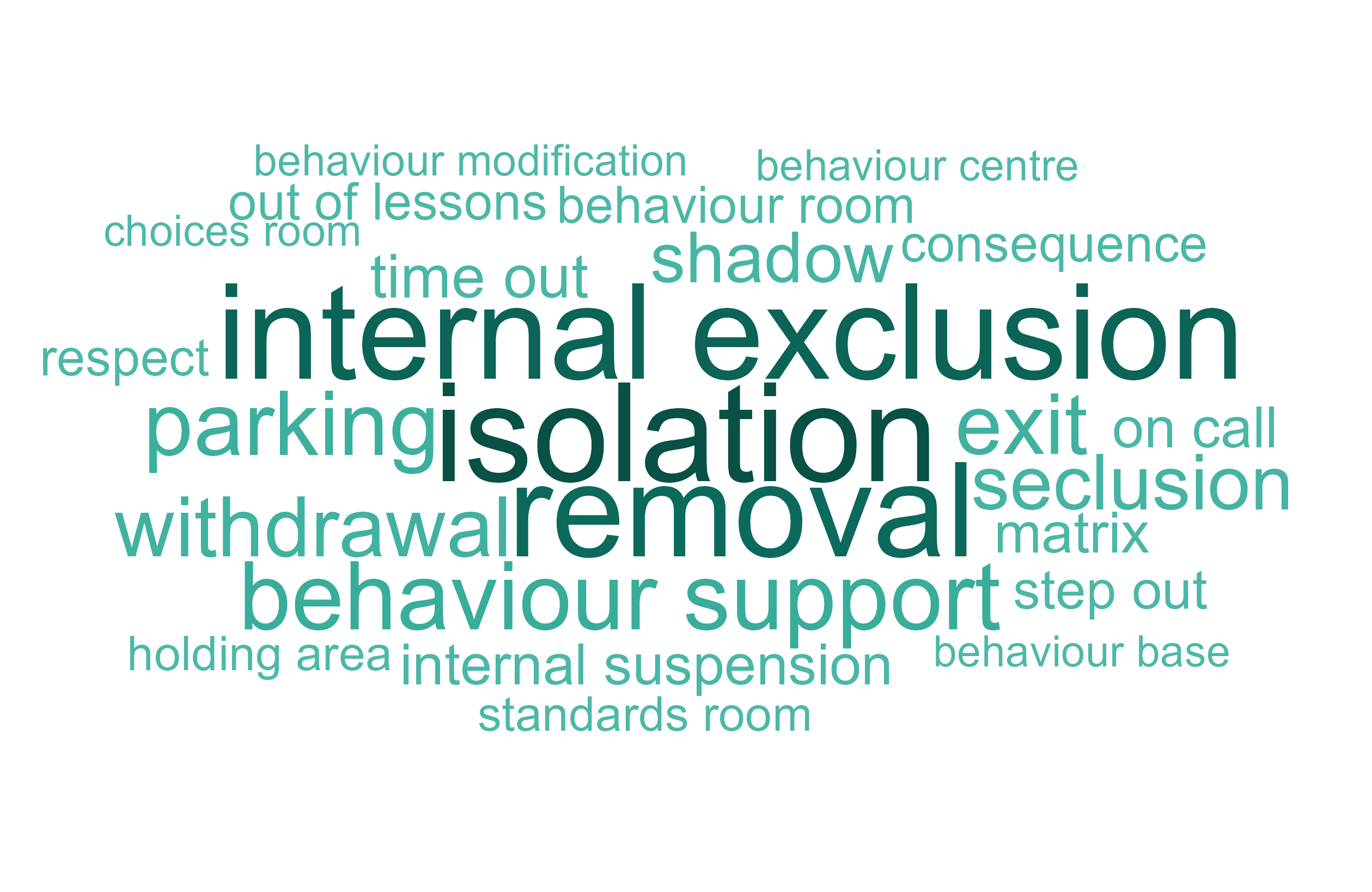
A clear focus on discipline and sanction is also evidenced within the classroom removal space names teachers and leaders reported. Many respondents report spaces whose names simply define the action of leaving the classroom, such as ‘removal’ or ‘withdrawal’. Where names do not refer to removal, they tend to directly name ‘behaviour’. By defining exclusion itself in their name or directly referencing behaviour, these spaces are situated as a disciplinary consequence, serving as a deterrent or sanction for misbehaviour.
Some names even take this a step further, with ‘isolation’ being one of the most common names referenced in this category and representing the punitive nature of these spaces. Furthermore, across space names there is no recognition of social and emotional regulation or development and, in cases such as ‘isolation’, an active effort to avoid peer interaction.
Figure 5: Discipline theme word cloud
Support
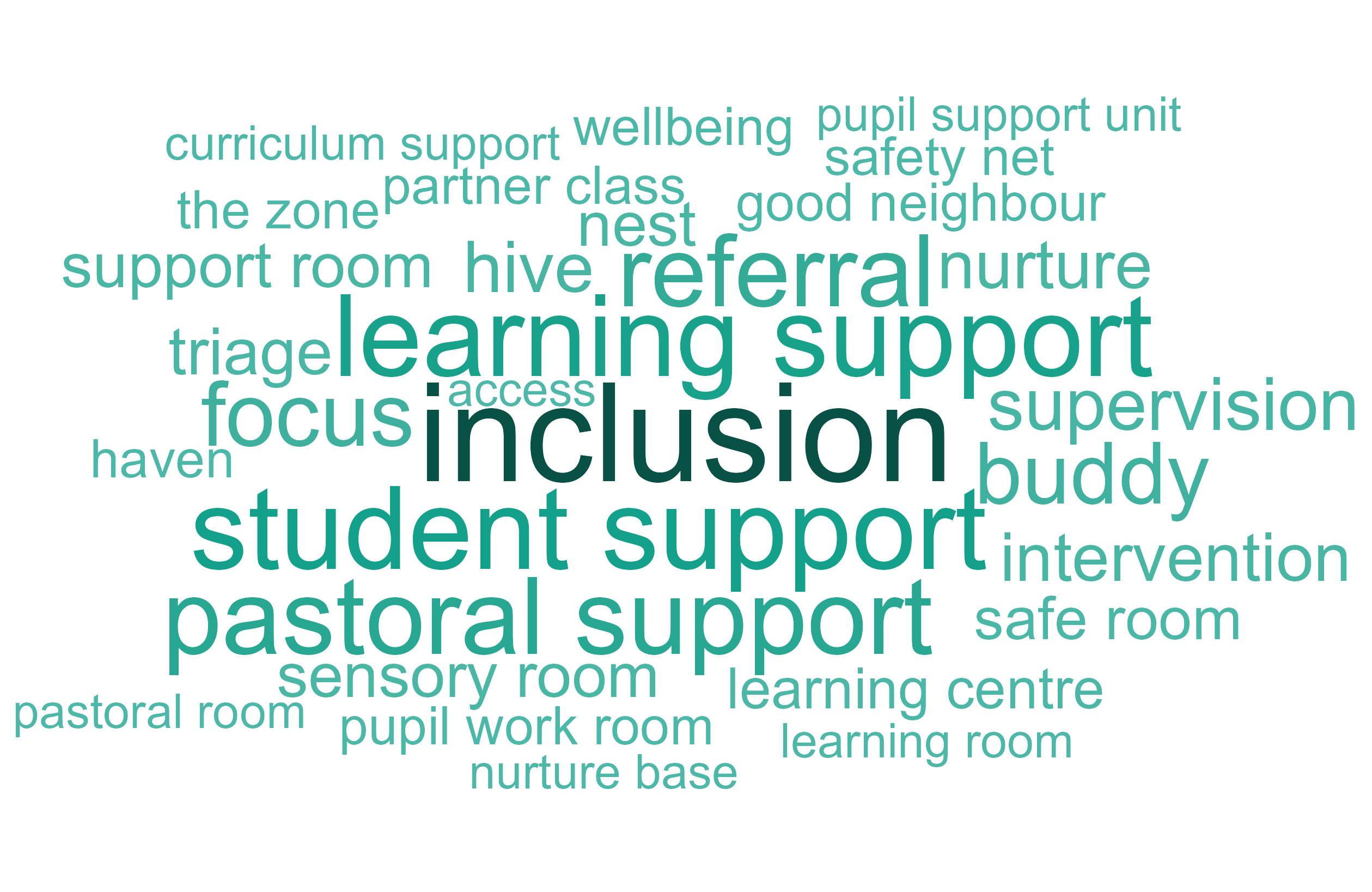
Support is characterised by a more diverse array of responses, although there are consistent references to ‘inclusion’ and to pastoral, learning, and student ‘support’. Some names highlight interpersonal relationships, such as ‘buddy room’ or ‘good neighbour’, or connote a sense of sanctuary through words like ‘safety’, ‘wellbeing’, and ‘haven’. In contrast to the discipline theme, here we see an emphasis on an input of support rather than removal / exclusion.
Yet, as with our reintegration theme, a focus on support for ‘learning’ or even ‘curriculum’ is also evidenced. Names centring around both pastoral and academic support may reflect a recognition of the link between behaviour and learning, as well as how schools attempt to create distinct spaces for academic learning support compared to behavioural or emotional support. Nevertheless, while spaces specifically tailored for academic support outside the mainstream are valuable in their own right, it is also important that these spaces continue to develop children’s social and emotional skills alongside academic learning.
Figure 6: Support theme word cloud
Other
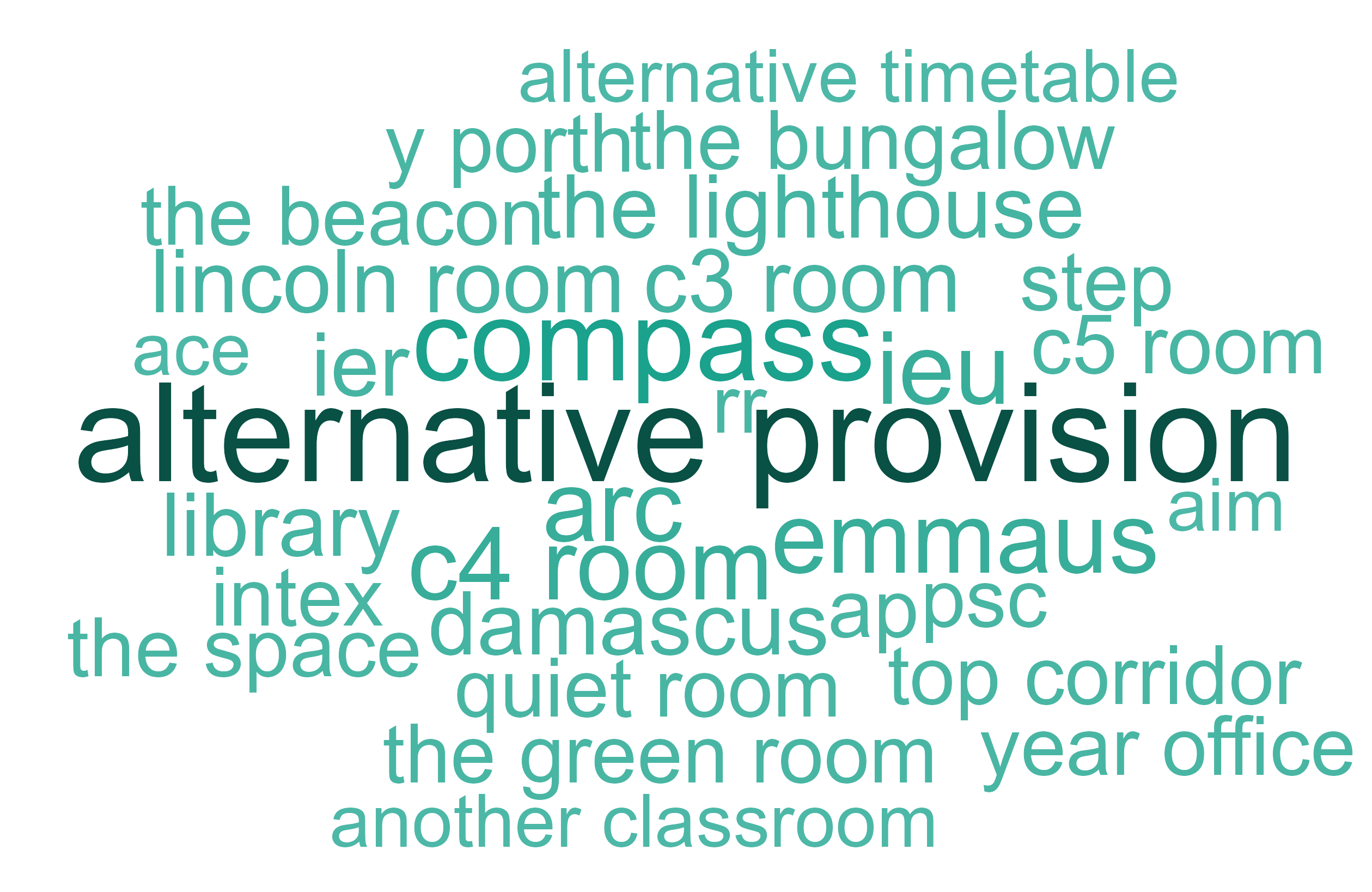
No coherent pattern emerges across our groups of ‘other’ names. Responses primarily consist of descriptions of generic spaces with no name, where teachers describe shared school spaces pupils can be sent to, such as ‘another classroom’, ‘office’, or ‘corridor’. Some teachers also report alternative provision spaces or names with unique symbolic terms. All other responses tended to refer to phrases or abbreviations that are ambiguous or unclear to us as external researchers.
Figure 7: Other theme word cloud
Alternative provision
Just over 1 per cent of respondents directly reference ‘alternative provision’. While we specifically aimed to differentiate between temporary removal and alternative provision through prior questions in our survey (see [additional information]), the inclusion of alternative provision named spaces demonstrates that in practice such differentiation is not always clear. Coupled with reports of growing use of alternative provision in schools, there is a clear need to better understand the differences between the use and outcomes of classroom removal spaces compared with alternative provision.
Symbolic or specific branding
A subset of schools appears to use names with some level of implied symbolic meaning, sometimes aligning with what might be a wider academy trust brand. For example, respondents list names such as compass, phoenix, bridge, Emmaus, and other location-specific titles. These names avoid direct references to removal or support and instead attempt to create a distinct identity for the space that likely aligns with a wider school culture.
FSM quartile
We also examine trends across respondents’ schools’ free school meals (FSM) quartile (see [additional information]), where Q4 represents schools serving the highest proportions of pupils eligible for FSM and Q1 represents schools serving the smallest proportions.
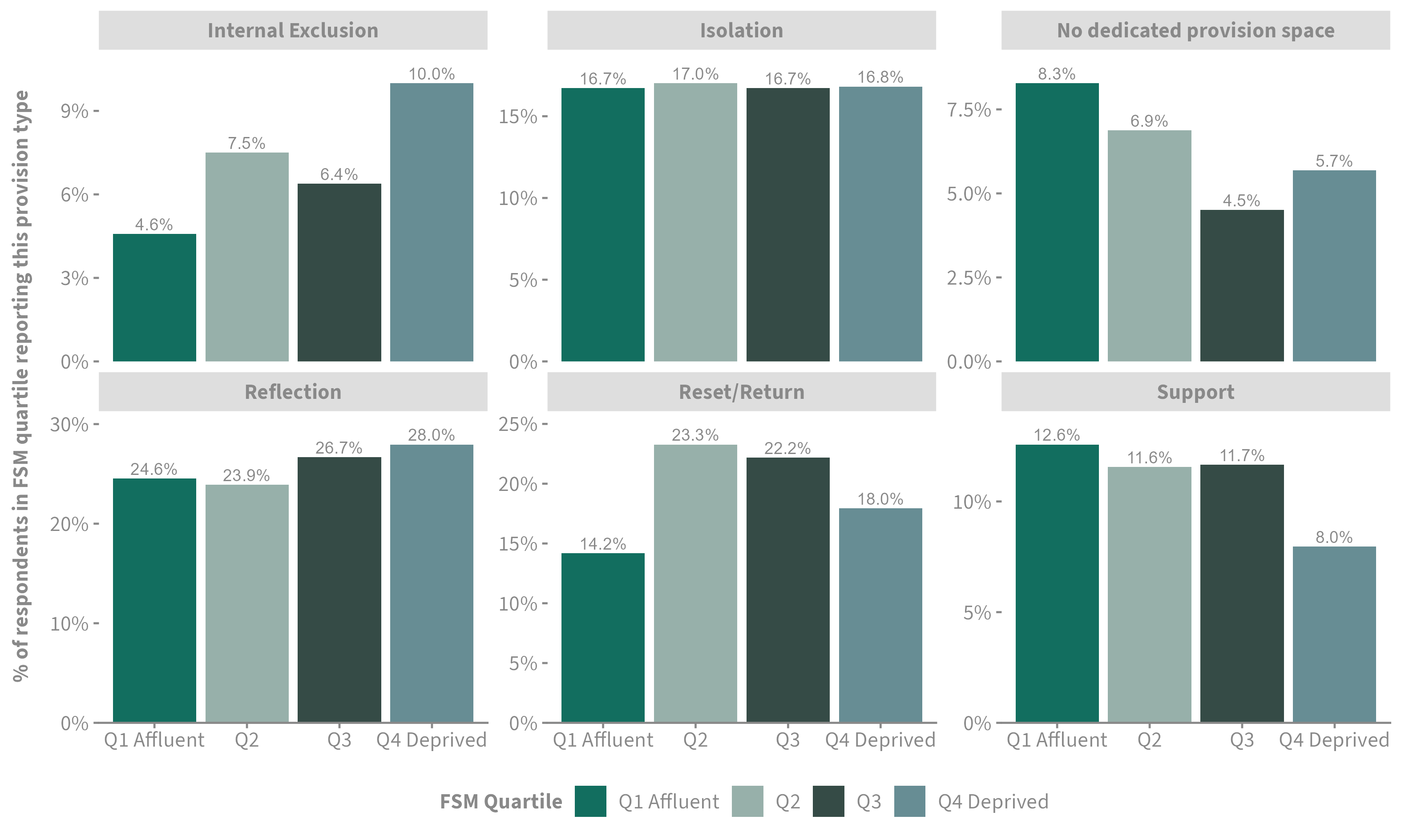
Figure 8 displays the prevalence of relevant subthemes across school FSM quartiles. Unlike our previous analysis, which found clear patterns in the policy framing and use of classroom removal across school-level disadvantage, the patterns between space names and FSM levels are less clear. That said, some tentative trends emerge.
Teachers in schools serving the highest proportions of pupils on FSM are more than twice as likely to report that they call their removal space ‘internal exclusion’ than those in the least deprived quartile. We also see that teachers in Q4 are the least likely to report spaces named around support, while also being marginally the most likely to name their space around reflection.
Behaviour is subjective and can be framed as both the child’s individual choice to misbehave or as a response to wider circumstantial and environmental factors. While in practice both framings can be justified, certain room name themes align more closely to one of these framings. For example, reflection tends to frame challenging behaviour as the result of poor decisions and choices on which children need to reflect and re-evaluate. On the other hand, support tends to frame challenging behaviour as a result of unmet need. Across FSM quartiles, we see that schools serving higher numbers of disadvantaged pupils are more likely to report names that frame behaviour as an individual choice, whereas schools serving smaller numbers of disadvantaged pupils are more likely to report names that frame behaviour as a response to wider environmental factors.
Figure 8: Subtheme prevalence by school-level disadvantage
Conclusion
Examining the diverse ways classroom removal spaces are named tells us a great deal about how schools conceptualise and frame removal, and demonstrates how an increasingly complex web of provision is developing outside the mainstream classroom.
Our analysis of the names of classroom removal spaces shows how schools tend to conceptualise removal around 1) reintegration, 2) discipline, or 3) support. These themes each represent a different positioning of classroom removal, with reintegration emphasising a return to the classroom, discipline emphasising removal and behaviour management, and support focusing on additional provision.
Across these three themes, tensions between emotional and academic discourses are evident, likely reflecting ongoing tensions within education between traditional academic learning and social and emotional development. Through our continued work, we will further examine to what extent these discourses are realised in practice, directly exploring the types of provision and support being offered outside the mainstream classroom. Further research may also wish to examine why and how schools name these spaces, as well as the impact of different removal practices on wider outcomes.
We also found that more than a quarter of teachers report that their school has multiple named spaces for pupils removed from the classroom. As the use of classroom removal expands across multiple spaces, it is important that the complex systems being created for these removed pupils are subject to the same level of oversight as mainstream provision and truly function in the best interests of the child.
Amidst rising levels of additional need in young people, practitioners and policymakers need to consider where the line should sit between needs that can be met in the mainstream classroom and those that must be met outside it. Alongside this, it is vital that sufficient resource, capacity and expertise is then available to ensure increasingly complex needs can be met in schools and beyond.