
In this blog, we describe variation in behaviour policies and outcomes in three inner London Boroughs: Hackney, Lewisham and Tower Hamlets. Our analysis finds that the written behaviour policies of state secondary schools in these areas vary in ways that align, to an extent, with outcomes linked to pupil wellbeing. While most schools share core processes such as classroom removal and internal exclusion, they differ in their use of restorative approaches, trauma-informed practice and support for vulnerable learners. These relational and pastoral elements were more extensive in schools with lower exclusion, suspension and absence rates, whereas schools with higher exclusion rates tended to outline more severe escalation routes for minor infractions. Although this does not prove a causal link, these patterns raise questions about how punitive and relational approaches shape pupils’ experiences at a time when exclusions, suspensions, absences and child mental health needs are high.
This exploratory study examined behaviour policies from 45 state schools across three London boroughs and highlights a clear need for large-scale research: our power analysis indicates that around 800 policies would be required for robust statistical testing. Behaviour policies offer publicly available insight into how schools structure discipline and support their pupils, and our work shows that they are currently an underused source of evidence.
Over the past decade, school approaches to pupil behaviour have become a major policy focus in England. Surveys consistently show that teachers view pupil behaviour as a growing challenge. In 2019, 82 per cent of teachers surveyed by NASUWT, the teacher’s union, agreed that behaviour issues were widespread nationally, and more than half of members felt there was a problem within their own school.[1] In 2024, 52 per cent of the teachers leaving the state education sector cited pupil behaviour as a reason.[2] In response, successive government initiatives, such as the Behaviour Hubs programme,[3] have focused on addressing disruptive behaviour, often by creating standardised and structured routines to build school culture.[4]
At the same time, children’s wellbeing and mental health has declined. One in five young people aged 7-16 now meet criteria for a probable mental health condition, compared to one in nine in 2017.[5] The Good Childhood Report 2025 has also highlighted that children are more unhappy with school than with any other aspect of their lives including family and peer relationships.[6]
Alongside these developments, schools have also experienced rising levels of pupil absence and have issued more suspensions and exclusions. The 2023/24 academic year saw the highest annual rates of suspension and exclusion on record,[7] and the rate of persistent absence doubled compared with 2019.[8] Researchers have found that these outcomes are associated with poorer child mental health and wellbeing, with some evidence suggesting a causal relationship between poor mental health and increased absence.[9][10][11][12]
There is emerging evidence suggesting that common behaviour management practices, such as internal exclusion, may negatively affect young people’s mental health [13][14]. However, most of this existing research relies on pupil or teacher-reported measures of behaviour management practice and tends to focus on only single aspects of practice – for example, punitive sanctions. To date, little quantitative research has used measures beyond self-reporting or adopted more holistic approaches which consider all components of a school’s behaviour approach.
Our approach
We analysed the written behaviour policies of 45 state secondary schools across three inner London boroughs – Hackney, Lewisham, and Tower Hamlets – where policies were publicly accessible on school websites.[15] These boroughs share broadly similar demographic and economic profiles but Hackney has higher rates of exclusion (0.16 per cent; the number of permanent exclusions per 100 pupils) and suspension (9.73 per cent;[16] the number of suspensions per 100 pupils) than Lewisham (0.03 per cent and 5.87 per cent) and Tower Hamlets (0.03 per cent and 3.46 per cent).[17]. Because the DfE requires all state secondary schools to publish a behaviour policy annually, these documents offer a consistent and publicly available source of data on schools’ stated behaviour management approaches.
We used a systematic text analysis approach to develop a coding framework capturing more than 30 features of behaviour policies. These included:
- Punitive sanction processes (e.g. internal exclusion process, classroom removal process, sanction severity)
- Pastoral and relational ethos (e.g. restorative approaches, trauma-informed practice, SEND awareness and adjustments)
- Structural and administrative features (e.g. monitoring behaviour data by protected group, student voice in behaviour policy)
We aimed to:
- Map variation in behaviour policies: how do policies differ across schools?
- Explore potential links with school outcomes related to markers of pupil wellbeing and mental health: are certain policy features more common in schools with lower or higher exclusion, suspension and absence rates (according to the latest DfE statistics)?
Do behaviour policies vary across schools?
A summary table showing the presence of the features we looked at by borough and school type is available at the bottom of this page.
Some behaviour policy features are near-universal. Across our sample, all or almost all schools:
- define a classroom removal process (97.8 per cent)
- define an internal exclusion process (97.8 per cent)
- include a bullying policy (95.6 per cent)
- cite DfE guidance (93.3 per cent)
- employ specialist inclusion or behaviour staff (100 per cent)
- have a rewards system in place (100 per cent)
Some elements were less consistent:
- A ‘no touch’ policy for pupils appears in 35.6 per cent of behaviour policies but is more common in Hackney schools (53.3 per cent; compared to Lewisham (16.7 per cent) and Tower Hamlets (33.3 per cent)) and academies (44.8 per cent; compared to 18.8 per cent in maintained schools).
- A role for student voice in behaviour management practice is mentioned in 41.9 per cent of policies.
- Behaviour management data monitored by protected characteristic is mentioned in 42.9 per cent of policies.
We also identified and scored differences in how schools describe pastoral or relational elements in their behaviour policies. Some components, such as Special Education Needs and Disabilities (SEND) awareness, were rated similarly across schools, with 84.4 per cent of schools describing specific processes for pupils with SEND, including adjustments and pastoral support plans, plus links to support from external professionals. (Scoring: 0=No mention of SEND; 1=Mentions inclusion in a generic and passing way, (e.g. ‘we support all pupils including those with SEND)’; 2=Specific internal processes present such as adjustments; pastoral support plans; SENDCo; 3=All of 2 plus explicit links to external professionals (e.g. CAMHS, EPs)).
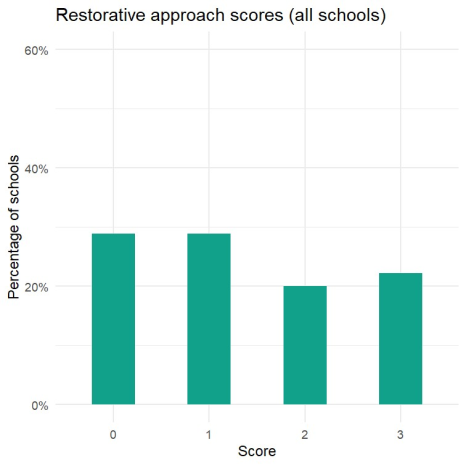
However, the use of restorative approaches varied considerably between schools. Restorative approaches aim to maintain and repair relationships between teachers and pupils and address the root causes of behaviour to facilitate change.[18] We identified and scored the extent to which schools embed restorative approaches in their behaviour policies(0=None; 1=Generic reference (‘restorative meeting/conversation’ after detention, class removal or other sanction); 2=Core principle (‘restorative approach’ appears as a subheading or core value); 3=Embedded with explicit process set out and staff training references). We found that:
- 28.9 per cent of policies made no mention of restorative approaches.
- 22.3 per cent described fully embedded restorative approaches with staff training and explicit processes.
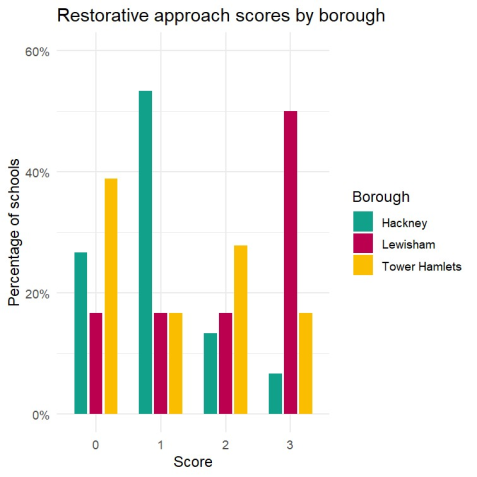
- Borough differences were stark: 50 per cent of Lewisham schools describe a fully embedded restorative practice strategy, compared to 6.7 per cent of Hackney schools and 16.7 per cent in Tower Hamlets.
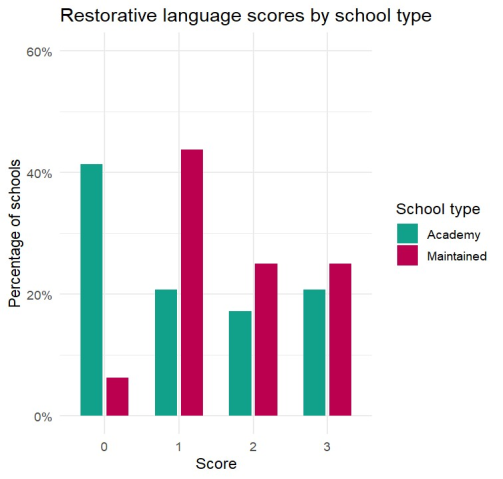
- 41.4 per cent of academies made no mention of restorative practice, compared to 6.3 per cent of maintained schools.
Figure 1: SEND awareness scores across all schools in the sample
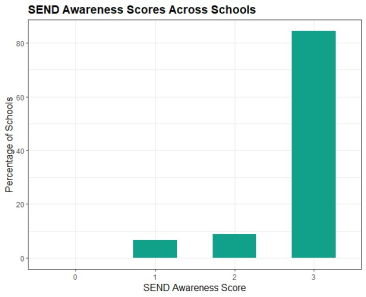
Figure 2: Restorative approaches scores across all schools, by borough and by school type
Does variation in behaviour policies relate to school outcomes?
We explored whether certain policy features varied between schools with differing levels of suspensions (pupil enrolments with one or more suspensions), exclusions (the percentage of permanent exclusions per 100 pupils), overall absence, and persistent absenteeism in the academic year 2023/24. We split the distribution of the rates in our sample into tertiles (three groups), giving us schools with low, medium and high rates of each outcome.
As well as considering levels of SEND awareness and restorative practice, we also identified and coded the extent to which schools described other structural and relational components of their policies. These included the sanction severity for minor infractions, the extent to which schools provide adjustments for vulnerable learners, including those who are care-experienced, and the extent to which behaviour management practices are trauma-informed, that is, they recognise the impact of trauma on a child’s behaviour and wellbeing.
The analysis below presents the two structural or relational components that varied the most for each of our outcomes of interest.
Exclusion rates
Of the features we above, the two that had the highest variation according to exclusion rate were:
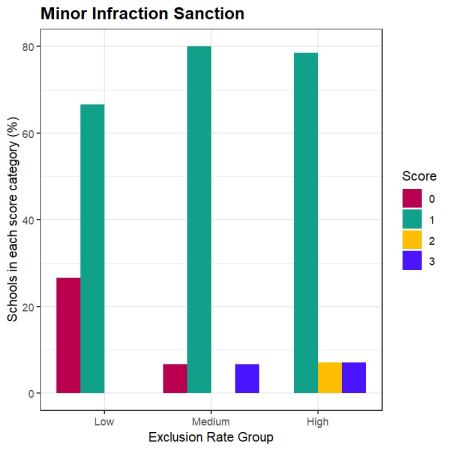
- Severity of sanctions for minor infractions (such as uniform and equipment infractions and chewing gum): We identified and scored policies based on the maximum sanction possible for a minor infraction (0=Teacher-level consequence only (confiscation/teacher-issued detention); 1=Central detention (same day/SLT); 2=Removal from class; 3=Internal exclusion possible). As seen in Figure 3, schools with low exclusion rates were much more likely to use teacher-level consequences for minor rule breaking. No schools with high exclusion rates used teacher-only sanctions for minor issues; more escalated directly to detentions or even internal exclusion.
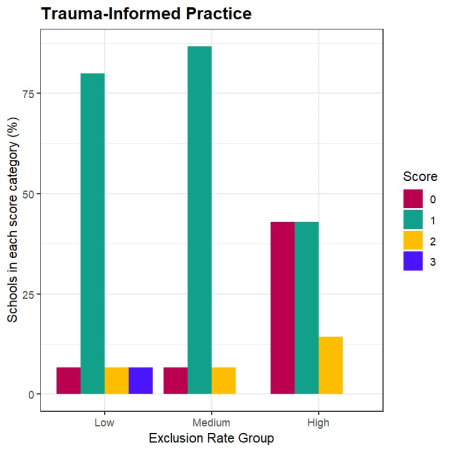
- Trauma-informed practice: We identified and scored the extent to which schools embed trauma and attachment awareness into their behaviour management policies (0=None: no mention of trauma or related training; 1=Generic: mentions ‘mental health’, ’emotional wellbeing’ or ‘pastoral support’ with no trauma/attachment training; 2=Specific internal process: uses ‘trauma-informed’ language; references staff training, internal strategy, or adapted responses; 3=All of 2, plus mentions working with external agencies and professionals). In low-exclusion schools, only 6.7 per cent made no mention of trauma-informed approaches. In high-exclusion schools, 42.9 per cent made no mention of these practices.
Figure 3: Behaviour management policy components with the most variation according to exclusion rate level (low, medium or high)
Suspension rates
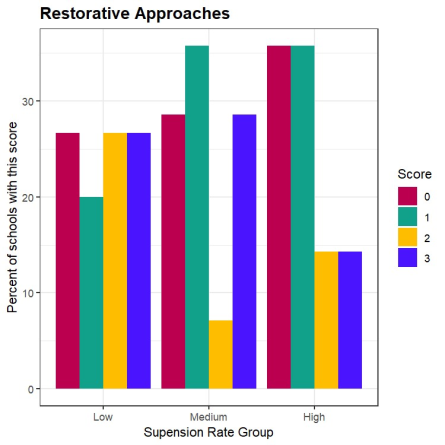
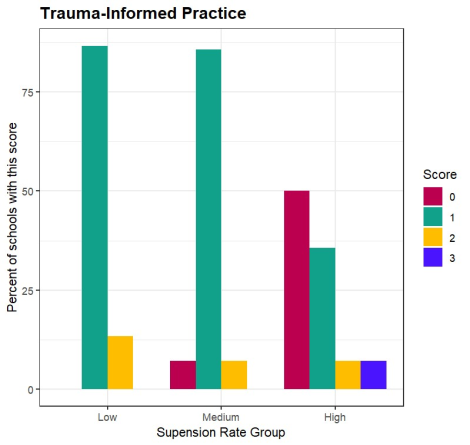
As seen in Figure 4, the two most differentiated approaches according to levels of suspension were:
- Restorative approaches: We identified and scored the extent to which schools embed restorative approaches in their behaviour policies (0=None; 1=Generic reference (‘restorative meeting/conversation’ after detention, class removal or other sanction); 2=Core principle (‘restorative approach’ appears as a subheading or core value); 3=Embedded with explicit process set out and staff training references). We found that 14.3 per cent of schools with high proportions of pupils suspended had fully embedded restorative approaches, compared to 26.7 per cent of schools with low suspension rates.
- Trauma-informed practice: We identified and scored the extent to which schools embed trauma and attachment awareness into their behaviour management policies (0=No mention of trauma or related training; 1=Generic: mentions ‘mental health’, ’emotional wellbeing’ or ‘pastoral support’ with no trauma/attachment training; 2=Specific internal process: uses ‘trauma-informed’ language; references staff training, internal strategy, or adapted responses; 3=All of 2, plus mentions working with external agencies and professionals). Fifty per cent of high suspension group schools made no mention of trauma-informed practice, but all schools in the low suspension group made some mention of trauma-informed practice.
Figure 4: Behaviour management policy components with the most variation according to pupil suspension rate level (low, medium or high)
Overall absence and persistent absenteeism
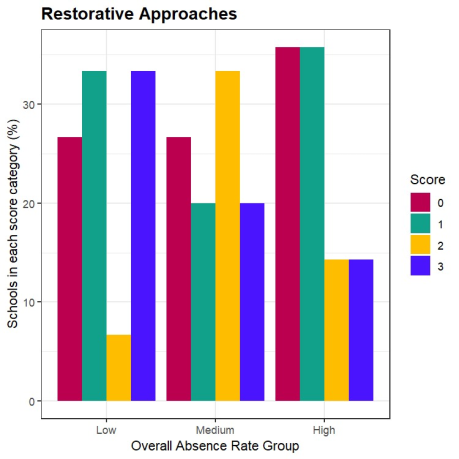
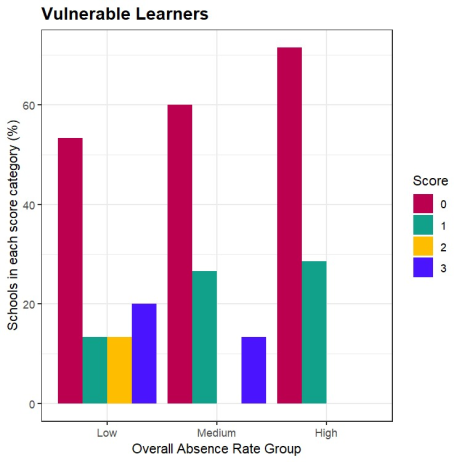
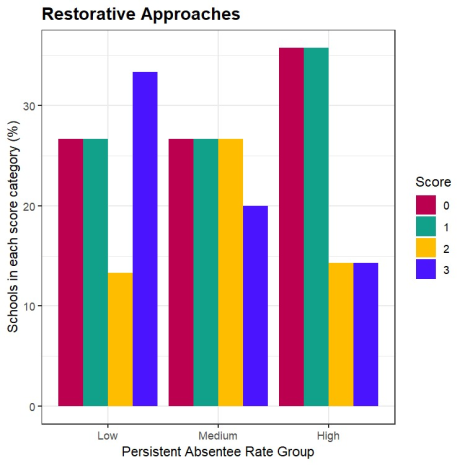
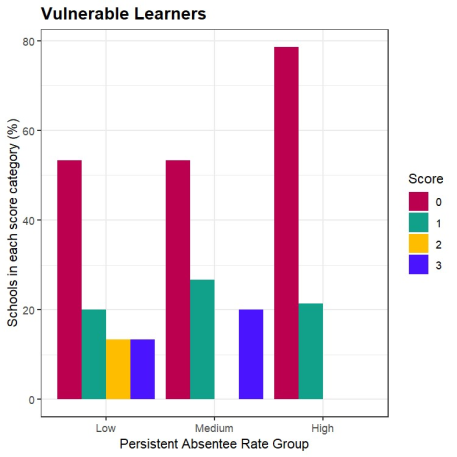
For both measures of absence, these behaviour policy features varied the most (see Figure 5):
- Restorative approaches: We identified and scored the extent to which schools embed restorative approaches in their behaviour policies (0=None; 1=Generic reference (‘restorative meeting/conversation’ after detention, class removal or other sanction); 2=Core principle (‘restorative approach’ appears as a subheading or core value); 3=Embedded with explicit process set out and staff training references). In low-absence schools, 33.3 per cent embedded restorative approaches compared to 14.2 per cent of high-absence schools.
- Support for vulnerable learners: We identified and scored the extent to which schools considered care-experienced children, refugees/asylum seekers and other trauma-experienced pupils in their behaviour policies (0=No mention; 1=Lists groups, or makes generic reference to those who might have specific needs for reasons other than SEND; 2=Group specific adjustments/processes: designated staff/LAC processes/tailored responses; 3=Adjustments plus external: as in code 2, but also with external resources and coordination). None of the high-absence schools described specific processes and adjustments for supporting vulnerable learners.
Figure 5: Behaviour management policy components with the most variation according to overall absence and persistent absentee levels (low, medium or high)
What does this mean?
Our analysis shows that while schools in three London boroughs share certain core structures and processes (such as classroom removal and internal exclusion processes) there is substantial variation in the relational, pastoral, and contextual features of behaviour management policies.
Crucially, these policy differences appear to align to some extent with key school outcomes associated with pupil mental health and wellbeing. In particular:
- Restorative, trauma-informed, and vulnerable-learner-focused policies were more common in schools with lower exclusion, suspension, and absence rates.
- Schools with higher exclusion rates tended to outline more severe escalation pathways for minor infractions.
These findings do not necessarily establish that policy features cause better or worse outcomes for pupils. It is possible that schools with more punitive structures may worsen behavioural and wellbeing-related outcomes. However, it could also be that schools with fewer behavioural and attendance challenges find it easier to adopt relational approaches in the first instance. The direction of influence between behaviour policy and pupil outcomes is unlikely to be simple, and contextual factors such as levels of deprivation and special educational needs in the pupil community are likely to play a role – although the three inner London boroughs we cover are all broadly demographically similar. We also recognise that although behaviour policies outline a school’s official approach, we cannot know for sure how accurately they represent day-to-day practice or pupils’ experiences.
What is clear is that written behaviour policies vary in ways that are not trivial, and that these differences seem to align with outcomes closely related to pupil wellbeing and mental health. This alone should prompt further scrutiny.
A clear research opportunity
Written behaviour policies offer a publicly available record of schools’ behaviour management practices, and they are currently underused in research.
Although our sample of 45 schools provides valuable early insight, it is not large enough for reliable inferential statistics. We performed exploratory correlations between policy components and outcomes which indicated meaningful effect sizes for some variables (r ≈ .10-.40), but our power analysis showed that a sample of around 800 policies would be needed to detect these associations with confidence.
Our findings highlight a clear opportunity to strengthen the evidence base on the impact of behaviour management practice. We also demonstrate that schools’ approaches to behaviour are likely to be related to exclusion, suspension and absence, outcomes linked to child mental health. To understand how behaviour management practices shape pupils’ experiences and how they could be improved, we need large-scale and systematic analysis of behaviour policies and how they are enacted in practice. This work demonstrates that such research is possible, valuable, and urgently needed.
