
New data from the Department for Education (DfE) released today shows that the share of 16–24-year-olds in England who are not in education, employment or training (NEET) remains high, with more than one in eight young people not participating in the education system or labour market.
Addressing youth inactivity and disengagement is a crucial pillar of the government’s post-16 and skills strategy, but understanding what is driving this rise matters if policymakers are to design effective interventions.
Today’s figures show the headline NEET rate is down – if only very slightly. However, this conceals some significant structural shifts since the pandemic. In this blog, we explore five charts that unpack the rise in NEET rates over the last five years, and why the warning signs are visible before young people even leave school.
1. NEET rates are back to levels not seen since the aftermath of the financial crisis
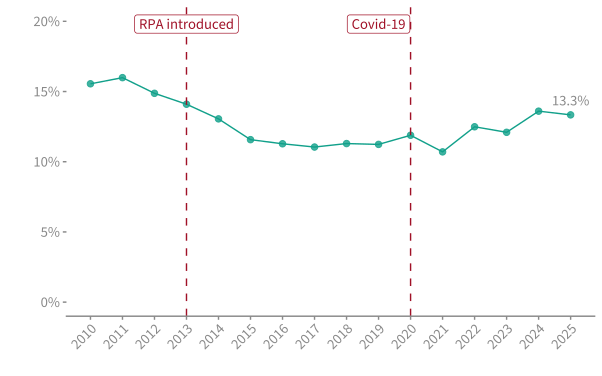
NEET rates are not a new problem. Following the 2008 financial crisis, the proportion of 16-24 year-olds who were NEET peaked at around 17 per cent, before gradually declining over the next decade, following the introduction of the Raising the Participation Age (RPA) policy in 2013.
Since the pandemic, this trend looks to have reversed, with NEET rates rising in 2022 and 2024 and now standing at 13.3 per cent in 2025. But while the headline numbers may look familiar, the underlying story is different to the post-2008 rise.
Figure 1: NEET rate among 16-24 year olds in England, 2010-2025
2. It’s not unemployment driving the rise, it’s inactivity
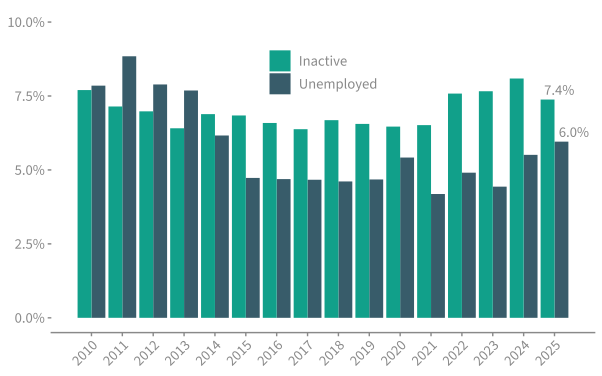
Before the participation age was raised to 18, the main driver of youth NEET was driven by unemployment: young people were looking for work, but weren’t able to find it.
Since 2013, this trend has reversed. Increasingly, youth NEET is driven by economic inactivity: young people who are not actively looking for work. A large portion of this inactivity is due to ill health, with mental health conditions accounting for a growing share. The pandemic accelerated this trend, with inactivity making up the majority of increases in NEET rates since 2020.
Figure 2: Reasons for 16-24 year olds being NEET in England, 2010-2025
3. Disengagement starts before young people even leave school
NEET is often framed as a post-18 problem. But the evidence suggests its roots lie earlier, in the patterns of disengagement that emerge at the transition into post-16 education.
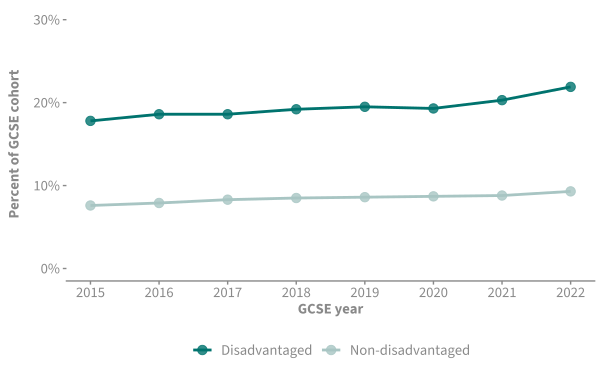
Our recent research shows that the participation gap between disadvantaged and non-disadvantaged pupils in Year 12 has widened in recent years, with disadvantaged young people increasingly less likely to stay in education beyond 16 compared to their peers.
Analysis by Impetus finds that young people without qualifications have NEET rates roughly twice those of peers qualified to GCSE level and above. Young people who exit education at 16 rarely return with higher qualifications — and without them, the risk of NEET roughly doubles.
In other words, the group most at risk of becoming NEET is already disengaging from education before they turn 18.
Figure 3: Percentage of GCSE cohort with no qualification aims in Year 12, by disadvantage status, 2015-2022
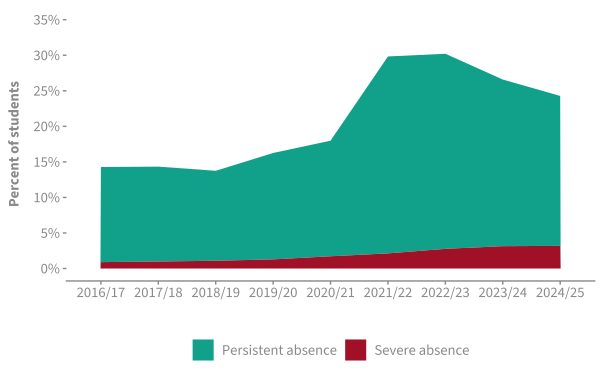
At the same time, absence rates have risen sharply among secondary school pupils since the pandemic. Both of these trends are likely to be contributing to the rise in NEET rates, as young people who disengage from education by 16 are more likely to become NEET later on.
Absence rates among secondary pupils appeared to peak in 2022/23, before falling in the following years.
Taken together with today’s figures showing a very slight decline in the overall NEET rates, this could be an early sign that improved engagement in secondary school may be reducing disengagement in post-16 education and training.
Figure 4: Persistent and severe absence rates among state-funded secondary school pupils in England, 2015/16-2024/25
4. The gender gap in NEET has been reversing
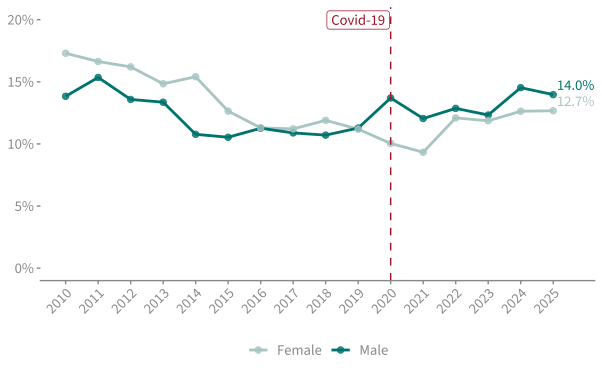
For most of the past two decades, women were more likely to be NEET than men, driven largely by caring responsibilities. In recent years, that pattern has reversed. Men now have higher NEET rates than women, a shift that has accelerated since the pandemic.
Our analysis last year found some surprising shifts in the gendered patterns of behaviour in recent years, with wellbeing indicators worsening among girls at a faster rate than boys – a reversal of the trend throughout the past decade. These trends are hard to reconcile with the opposite pattern in NEET rates, but it also suggests that the drivers behind youth disengagement are changing in different ways for male and female students.
Figure 5: 16-24 year old NEET rates by gender in England, 2010-2025
What should policymakers take from this?
The Milburn Review, launched by government in late 2025, is examining the rise in youth inactivity with a particular focus on mental health and disability as barriers to participation. We welcome that focus, with today’s data making clear the need for urgent action.
But the evidence presented here points to a broader lesson: NEET is not purely a labour market phenomenon. Its roots lie in inequalities that affect participation earlier in school. The widening disadvantage gap in Year 12 participation is a leading indicator of future NEET risk, and one that current policy levers are not adequately addressing.
Our 2024 report, Closing the Forgotten Gap, sets out one potential policy response to this problem: a 16-19 student premium, providing targeted support for disadvantaged young people at the transition into post-16 education, with the aim of keeping more young people in education and on track to achieve qualifications that will help them avoid NEET.